
 By
·
8 minute read
By
·
8 minute read
BLUF
Armenia has positioned itself as a new technology hub on the frontier of Europe, opening the National Supercomputer Center of Armenia in 2024, signing an AI and Semiconductor Innovation Partnership MOU with the United States in 2025, and hosting the new Firebird Armenian AI factory in 2026. These initiatives build on a long-standing focus on science and technology, dating back to the Soviet era, but future success may be contingent more on Yerevan’s ability to navigate its new multi-aligned foreign policy than on its domestic policies.
Key Points
- Armenia is seeing growing interest from technology companies, positioning itself as a high-tech and AI hub for frontier Europe and the bridge into Central Asia
- Over the next two years, Armenia has both a window of opportunity and several hurdles to overcome to break free from its long over dependence on Russia
- Armenia’s pursuit of EU membership is raising economic strictures and political threats from Russia and its EAEU
- Armenia’s role as a land bridge between Central Asia and Europe, bypassing Russia and Iran, is contingent on its peace negotiations with Azerbaijan and Russian influence in Armenia rail
- Ultimately, Armenia’s value as a technology hub will be shaped by its ability to break free from its geographic and geopolitical constraints, with the next two years proving critical
Armenia sits at a critical juncture, both geographically and politically. Its landlocked location in the Caucasus is both isolating and provides an opportunity to emerge as a land bridge between Central Asia and Europe. Politically, Yerevan is pursuing an active multi-alignment strategy, embracing the United States and China, easing long-standing tensions with neighboring Türkiye and Azerbaijan, and pursuing European Union (EU) membership as an option to its current membership in the Russia-dominated Eurasian Economic Union (EAEU). Armenian Prime Minister Nikol Pashinyan, while not exactly popular at home, is pushing in several directions at once in an attempt to break Armenia free from its past isolation. He faces key challenges over the next year or two, including threats of exclusion from the EAEU, constitutional adjustments to finalize the peace deal with long-time rival Azerbaijan, and potential Russian influence in its rail lines that can delay re-opening border crossings with Türkiye.
The Eurasian Economic Union (EAEU) versus the European Union (EU)
Pashinyan’s outreach to Europe, and assertions that the country will pursue the steps necessary to request membership, has been met with economic punishments from Russia and very public challenges from Russian President Vladimir Putin. Moscow is effectively blocking Armenian agricultural exports to Russia (a key part of Armenia’s economy) through increased application of phytosanitary inspections and regulations as a lever to dissuade Yerevan from pursuing EU membership. Moscow has demanded that Armenia hold a referendum on whether the country wants EU or EAEU membership, with Putin in his latest meeting with Pashinyan on the sidelines of the SCO summit repeating his assertion that even pursuit of EU membership is effectively a statement of withdrawal from the EAEU. Russia has gained Kazakhstan’s backing in suggesting that Armenia may face suspension from the EAEU later this year if the country doesn’t back down from its EU goals, though the Union has no formal mechanism for expelling members, something Armenia has emphasized.
Thus far, Pashinyan has tried to walk a careful balance, stating on several occasions (including the SCO meeting) that there can be no referendum until after a formal membership bid is proffered, but adding that there is little chance of a bid anytime soon. Further, he has highlighted that, at least for now, Armenia’s economy is tied to the EAEU, reducing any potential that the country would seek to leave Russia’s economic union anytime soon. Over the past year, Pashinyan has traveled to Moscow, held phone calls with Putin, and met the Russian president in person at the SCO summit, and used each occasion to try to reassure Moscow that Armenia’s attempts to expand its foreign relations is not a direct challenge to Russia. Nonetheless, Pashinyan made it a point not to speak in Russian during his address at the SCO meeting, restating that Armenia is actively seeking to widen its international relations. Separately, he has questioned the strategic relationship with Russia, citing Moscow’s inability or unwillingness to assist Armenia in the latest round of conflict with Azerbaijan.
Moscow sees any move by Armenia toward the EU as a direct challenge to Russian influence and national security, and Putin continues to take a hard line toward Pashinyan himself. Nonetheless, we do not expect the EAEU to suspend Armenia at the December summit in St. Petersburg. As noted above, the EAEU has no mechanism for censure or suspension, only for members that choose of their own accord to leave the Union. Trade within the union overall is relatively low, and for Belarus, Kazakhstan, and Kyrgyzstan, Armenia’s removal would be more symbolic than economically significant. Armenia itself risks the most from leaving the union, with as much as 35% of its economy tied to its EAEU trade, with most of that connected to Russia. However, kicking Armenia out, or suspending its participation, undermines the political significance of an already weak organization, further eroding perceptions of Russian influence.
Further, while Kazakhstan has backed Moscow’s calls for challenging Armenia’s potential pursuit of EU membership, Astana has an interest in Armenia’s expanded trade and infrastructure connections, and in the country’s technology drive. Earlier this year Kazakh deputy prime minister Zhaslan Madiyev even attended the opening ceremony for San Francisco-based Firebird’s new AI factory in Armenia, and the Kazakh leadership sees the potential land corridor through Armenia as an important additional trade route further connecting Central Asia to Europe and enhancing the region’s role as a major trade corridor between Europe and Asia.
Transit Connections to Türkiye and Azerbaijan
Armenia is both landlocked, and has effectively been cut off from most land-route trade due to long-standing political and security issues with Türkiye and Azerbaijan. The 2020-2023 conflict between Armenia and Azerbaijan saw Russia fail to significantly assist its Armenian ally, while Türkiye took an active role in supporting Azerbaijan’s military actions. In the end, Armenia lost control of the contested Nagorno-Karabakh region. Despite (or perhaps because of) these losses, Armenia has taken steps to ease tensions with Azerbaijan and Türkiye, and to seek alternative political and economic backing to its traditional reliance of Russia. Armenia was a willing participant in 2025 U.S. backed mediation with Azerbaijan that effectively required Armenia to relinquish claims on territory and allow Azeri transit rights, but also hinted at U.S. investment in Armenian transportation infrastructure, and parallel deals on technology cooperation.
Armenia and Türkiye are actively working to reopen severed trade routes, particularly rail lines, to facilitate both Armenia-Turkish trade and greater trade between Central Asia and Europe via the South Caucasus and Türkiye (bypassing both Russia and Iran). Longstanding political and social strains, driven by differing historical interpretations of the 1915-23 “Armenian Genocide” by the then Ottoman Turks, remain unresolved, but both sides are softening their tone to allow economic reconciliation without formally accepting the other’s position. Türkiye is preparing a broader re-opening of cross border travel for Armenians, and both are feeling pressure to re-establish the rail lines as they seek to compete with the Trans-Caspian Corridor, which connects Central Asia via the Caspian Sea to Azerbaijan, then flows by rail to Georgia, and into the Black Sea to Europe. The Trans-Caspian Route bypasses both Armenia and Türkiye, and is already in operation.
Two key factors impact the viability of the southern route via Armenia and Türkiye. The first is Armenian relations with Azerbaijan, the second is Russian influence over Armenian rail lines. In August 2025, the United States promoted the so-called Trump Route for International Peace and Prosperity (TRIPP), a rail connection across Armenian territory between two separated parts of Azerbaijan, allowing rail lines to flow from the Caspian to Türkiye while bypassing Iran (the current route between the two parts of Azerbaijan). To finalize their peace agreement, Azerbaijan is pushing Armenia to pass a constitutional amendment to remove any claim to Nagorno Karabakh, something politically unpopular in Armenia, and something Pashinyan currently lacks enough seats in parliament to ensure, though he is still pursuing the goal.
The second challenge comes from a 2008 30-year concession giving management of Armenia’s entire rail network to a wholly owned subsidiary of Russian Railways. Completion of the TRIPP and of the final rail connections to Türkiye, then, requires Moscow’s acquiescence, something the Russian leadership has little incentive to provide. While Yerevan has, in the past, nationalized industries when it felt private ownership was a risk to the state, Pashinyan is trying to strike an amicable deal with Moscow, and is likely to pursue buyouts of select sections of the rail network to facilitate both TRIPP and fast track connections to Türkiye. If the rail projects cannot move quickly, within the next year or so, Armenia risks being left behind as the Trans-Caspian Corridor continues to expand, and as Washington may lose interest in TRIPP.
We expect Russia to demand that any deal on the rail lines be connected to Armenia’s tacit rejection of EU membership. Moscow has little incentive to see its leverage in Armenia further deteriorate, but significant Russian intransigence could lead Pashinyan to accelerate Armenia’s turn to the West. Washington’s decision to provide technology transfer waivers to Firebird, and growing U.S. technology interest in Armenia, highlight the interest many connected to the U.S. administration have in expanding operations in the South Caucasus and Armenia in particular. In the near term, then, there appears enough interest to keep the U.S. administration engaged, and toward this end Pashinyan recently reached out to U.S. President Trump to guarantee the continued commitment to the TRIPP.
Domestic Politics and International Hedging
Pashinyan is not exactly popular in Armenia, but the opposition is fragmented, and several high-profile individuals have very clear ties to Moscow - economically and politically. Yerevan is cracking down on perceived vectors of Russian influence, arresting key political individuals and threatening intervention in the Armenian Apostolic Church. Pashinyan is reaching out to opposition members in parliament, seeking to tease a few away from their main parties to build enough of a coalition to reform the constitution. This will require individual and localized concessions, which can raise concerns of internal corruption. It is unclear if Pashinyan has enough to offer to build the coalition he wants without undermining his own party and existing coalition, but we expect him to intensify his political efforts through a combination of economic and political incentives and threats.
As he manages internal opposition, Pashinyan is also balancing regional influence operations and his broader attempt to pursue a multi-alignment strategy. Russia remains the single largest source of foreign influence in Armenia, but Iran also has historic ties and reach, and Tehran does not like to see a strengthened Armenia. Ethnic Armenians make up one of the largest recognized ethnic groups in Iran, and Armenian Christians are given special recognition as well. A strong independent Armenia could shape the political and social behavior of Armenian Iranians, following similar patterns of cross border ethnic concerns throughout Asia and the Middle East. Armenia’s outreach to Türkiye is relatively new, and better relations with Türkiye are critical if Armenia is to distance itself from Iran and Russia. But Türkiye needs Armenia to finalize its peace process with Azerbaijan, to ensure the rail connections, and while Ankara is less concerned about the Armenian constitutional change, it cannot convince Baku to back down on its demands.
Further abroad, Armenia has expanded its ties to Europe and the United States, and Washington currently sees Armenia as central to countering Russia and Iran, but also to countering China, which has strongly backed the Trans-Caspian Corridor. The TRIPP is as much or more about China than about Armenia, and thus there remains relatively strong interest from Washington on pursuing the project. Yet Armenia, in its multi alignment strategy, is also courting Chinese ties, something that may create friction down the road.
Export Controls and Technology
As a final note, Armenia has put in place several export controls in order to adhere to U.S. regulations and reverse Armenia’s role as a key conduit for illicit technology flows to Russia. Yerevan is unlikely to lift these restrictions, as they would undermine its outreach to the United States and the European Union, though it will seek to walk a careful balance between Western interests and outreach to China. Armenia is also subject to technology transfer restrictions from the United States, but Washington does provide waivers (see the case of Firebird), and we expect this to remain the main way higher-end technology transfers are approved. Finally, Armenia is looking to link its mineral resources, including domestic Molybdenum mining, to U.S. initiatives to limit mineral dependency on “hostile” countries. For now, Yerevan appears willing to use transactional policies to keep U.S. interest in supporting its moves toward multi-alignment and reducing its over dependence on Russia.
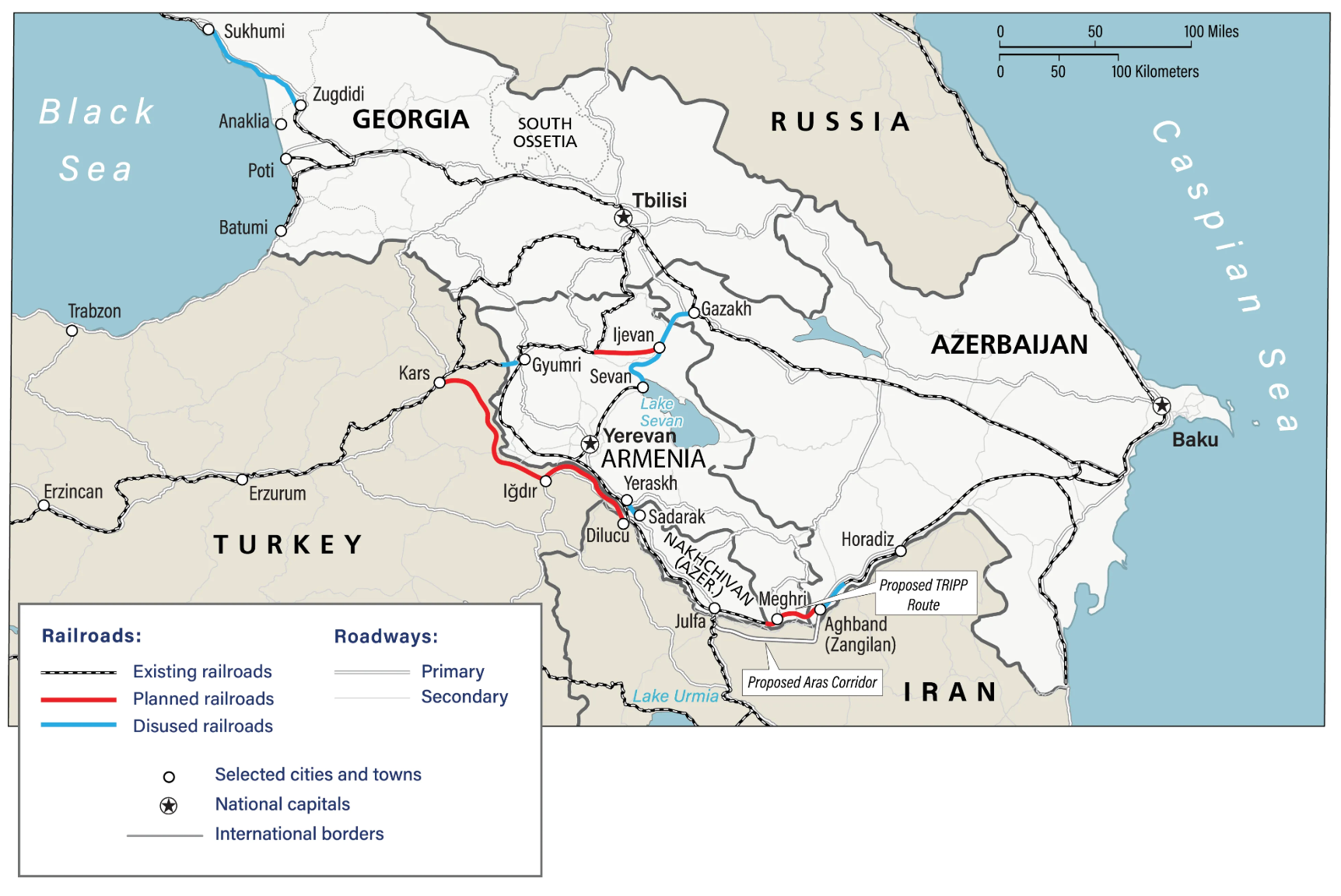
Citation: Map from de Waal, T., Kochinyan, A., & Shiriyev, Z. (2026, April 1). Rewiring the South Caucasus: TRIPP and the new geopolitics of connectivity. Carnegie Endowment for International Peace. https://carnegieendowment.org/europe/research/2026/03/rewiring-the-south-caucasus-tripp-and-the-new-geopolitics-of-connectivity
Additional author contributions from Ethan Burk