
 By
·
4 minute read
By
·
4 minute read
BLUF: Beijing is closely watching Taiwanese local elections in 2026 and national elections in 2028, and the outcome of these will influence how Chinese leaders perceive their options to manage Taiwan: if the opposition Kuomintang (KMT) is able to recover from its declining fortunes, Beijing may feel confident using economic enticements and soften its military coercion, but if the ruling Democratic Progressive Party (DPP) continues to dominate Taiwanese politics, then Beijing is likely to forgo incentives and default to more assertive economic and military coercive means to deter moves toward Taiwanese independence.
Key Points
- Taiwan’s 2026 local and 2028 general elections will shape Beijing’s Taiwan strategy.
- Beijing sees the KMT as a more viable partner, and will use economic and political enticements to encourage and reward KMT political gains.
- Should the KMT continue to decline, or lose its partnership with the DPP, China’s leaders will see little benefit from incentives, and accelerate coercive actions.
- Longer-term social dynamics in Taiwan make any form of reunification unlikely.
- Nonetheless, the predominant preference in Taiwan is for long-term status quo, not independence, suggesting that Beijing’s military exercises are having an impact on Taiwanese politics.
Analysis: The November 2026 local elections are a midterm referendum for the DPP, and a launchpad for the 2028 national elections. While Taiwan’s local elections have less impact on a national level, they serve as a signal indicator for political trajectories. The KMT in coalition with the Taiwan People’s Party (TPP) currently holds 53% of the seats in the Legislative Yuan, a simple majority that can undermine the initiatives of the DPP executive. However, the KMT’s dependence on the upstart TPP is reminiscent of Japan’s Liberal Democratic party (LDP) and their long coalition with the New Komeito Party - the tiny minority partner serves to check the larger coalition partner’s agenda. Without the TPP, the KMT falls below a majority, with just 46 percent of the seats. The KMT also holds a majority of local government positions, a key source of influence domestically. The KMT-TPP coalition combines two disparate voting blocs, with the TPP’s base composed of younger generations and the KMT’s almost exclusively over 40. While this coalition effectively rivals the DPP, it is united more by convenience than structural ties.
Attempting to stage a resurgence, the KMT has pivoted towards domestic issues to pull voters away from a more independence-minded DPP. Increased Chinese military posturing over the past few years has appeared to coincide with a shift in Taiwanese citizen’s support for long-term status quo ante relations, with some decline in support for independence (see below for more on Taiwanese sentiment polling). China prefers a KMT-led government, as in recent years the KMT has been more amenable to improving cross-Straits relations and remains more closely aligned with business interests that operate both in Taiwan and in Mainland China.
Should the KMT regain lost ground, we would expect reduced frictions and increased economic incentives to expand cross-Strait connectivity. This would ease tensions and risks of disruptions, but could also reduce the current willingness of Taiwanese companies to invest more outside of Taiwan and China, thus perpetuating the supply chain dependencies of Taiwan and keeping the Island firmly caught in the middle of U.S.-China competition over artificial intelligence and advanced semiconductors.
Should the KMT continue its decline, it would likely push Beijing towards enhanced coercive pressure. With a weakened accommodationist KMT, the incentives provided to key sectors of the economy lose their political utility. The coercive stick becomes Beijing’s primary instrument – intensified military posturing, gray-zone operations, export controls and wider economic coercion, which could include both the detention of key personnel in China and ripple out to foreign partners of Taiwanese businesses.
The local elections later this year are the early indicator, the 2028 national elections will shape the next five years of China-Taiwan dynamics.
—-------------------------------------------------------------------------------------------
About Taiwanese Sentiment Data
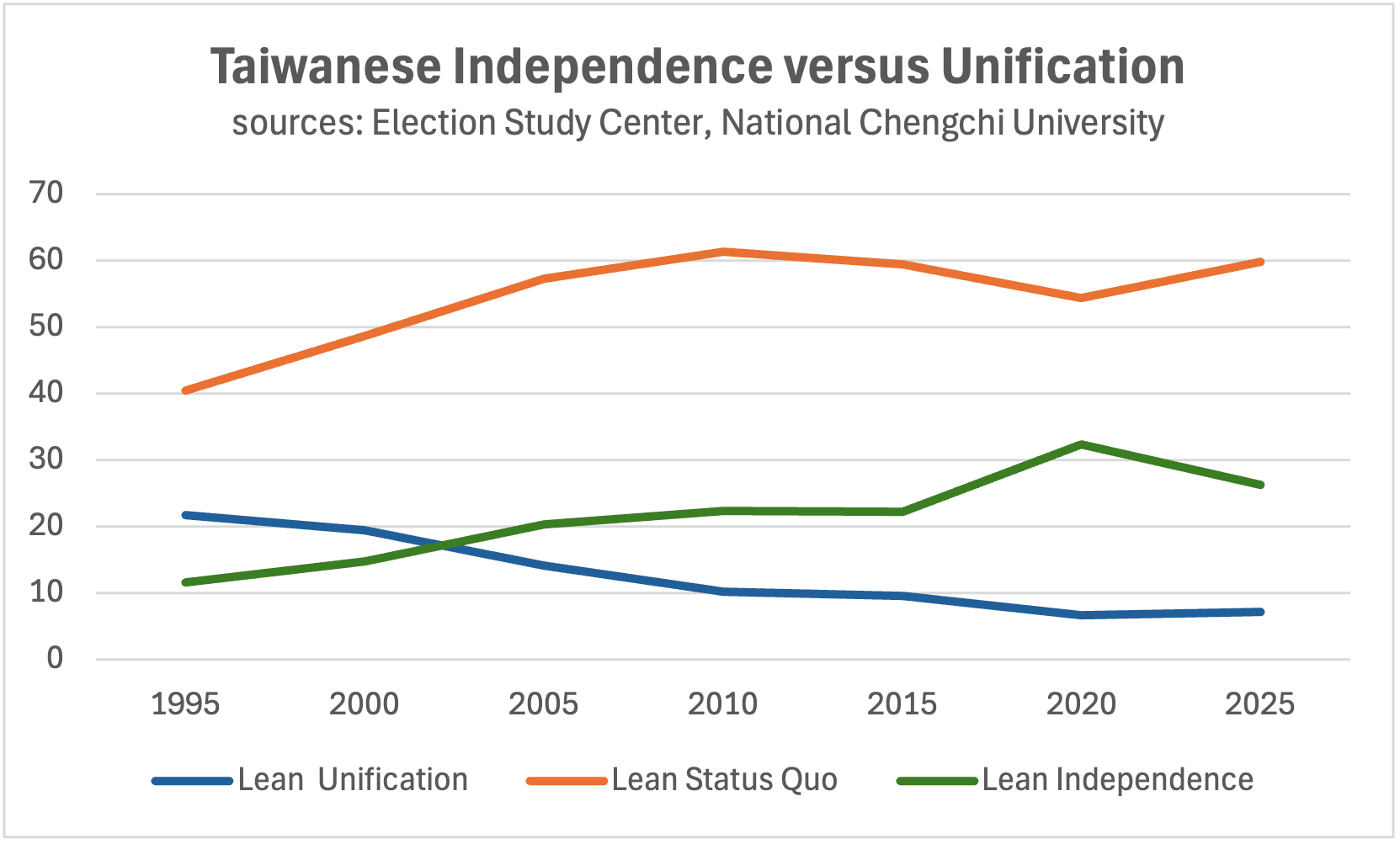
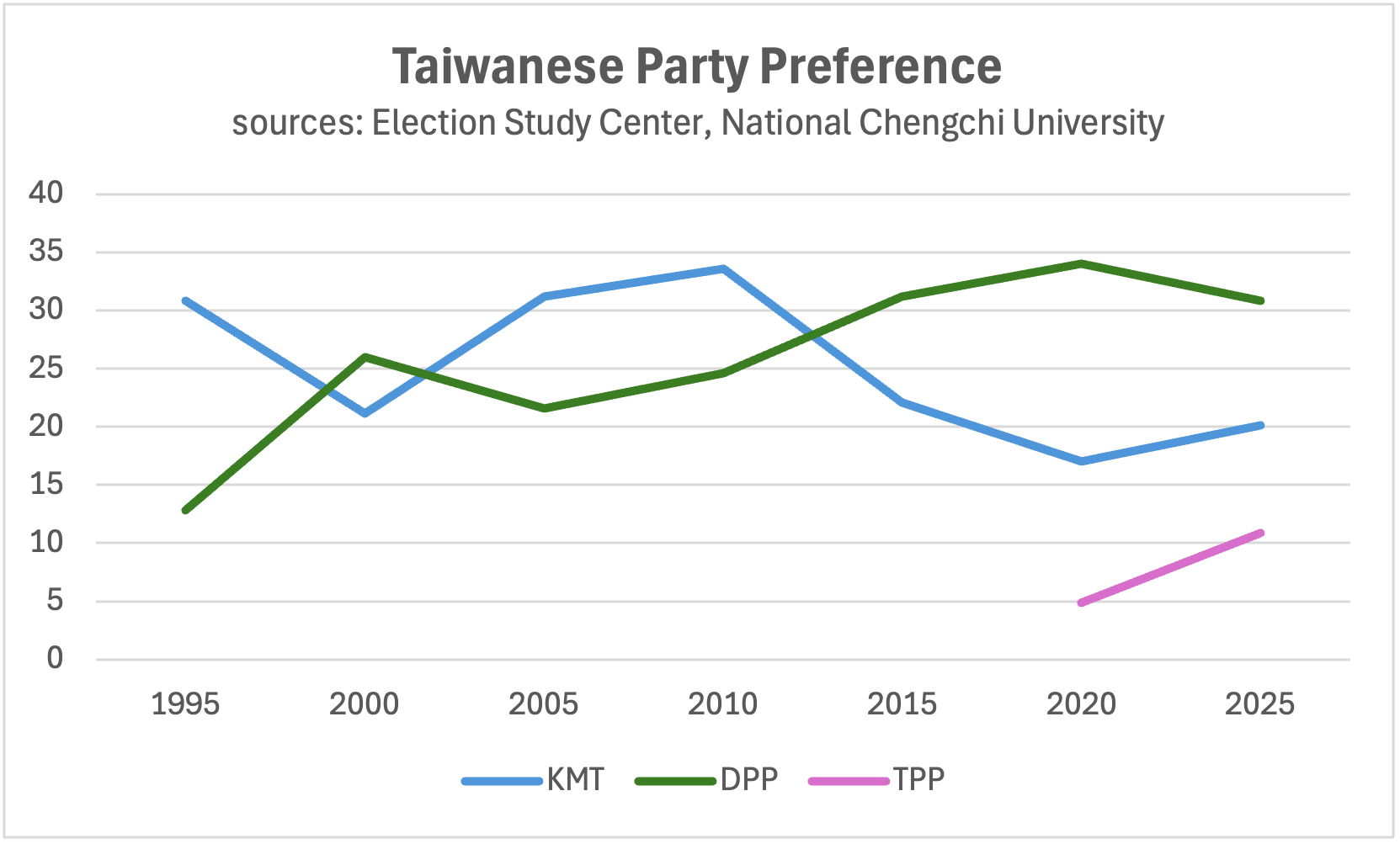
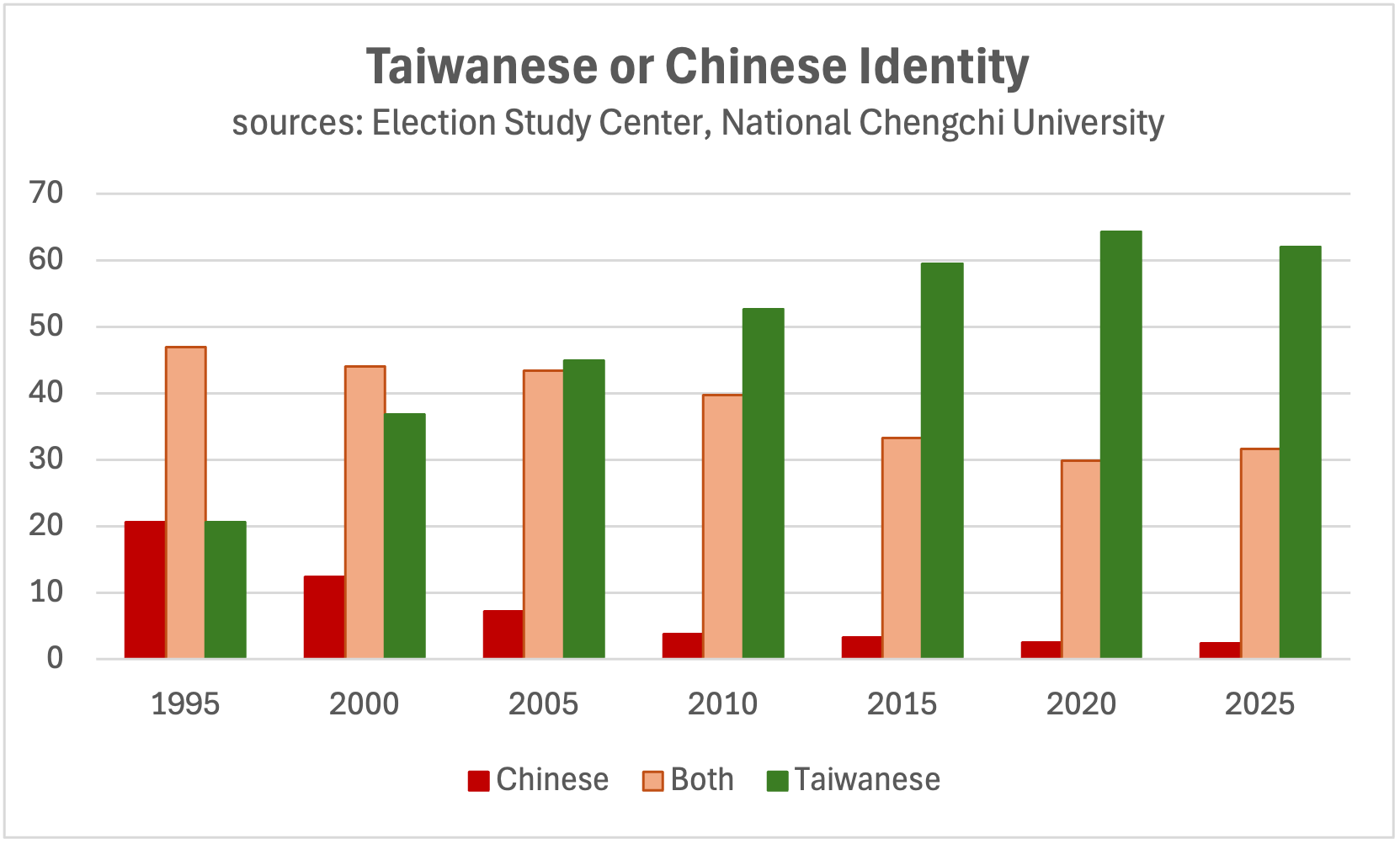
The 30+ years of survey data from the Election Study Center at Taiwan’s National Chengchi University provides insights into core political and social perceptions in Taiwan, dating back even before the first full direct elections as Taiwan transitioned to a democracy. The survey data shows a pattern of decreasing affiliation with the Kuomintang (MKT), and an increasing affiliation with the Democratic Progressive Party (DPP), which parallels the shift in national and cultural identity (whether respondents consider themselves Chinese, Taiwanese, or both). It also shows a slow but steady shift in support for ultimate reunification to support for independence, though even support for quick or slow independence remains well below 50%, peaking at just over 32% in 2000. Perhaps more notably, though not shown on the consolidated graph above, there was a jump in support for rapid independence between 2018 and 2020 (from 15.1% to 25.8% support), falling back down to 21.9% by 2025. Between 2020 and 2025, support for indefinite status quo rose from 25.5% to 33.5%, perhaps reflecting concern over the more assertive Chinese military drills around the island, and a greater recognition of Chinese military coercion.
The chart above combines some of the data fields from the original Election Study Center data. Lean Unification encompasses “Unification as soon as possible” and “Maintain status quo, move toward unification.” Lean Independence combines “Independence as soon as possible” and “Maintain status quo, move toward Independence.” Lean Status Quo includes both “Maintain status quo indefinitely” and “Maintain status quo, decide at later date.” On part affiliation, it is notable that, with the exception of a single year (2011), independent or non responsive is always the highest percentage of respondents. On identity (Chinese, Taiwanese, or both), we can consider two different aspects at play - perception of ethnic identity, and perception of national identity. The question does not distinguish, but the responses clearly show a decline in any personal affiliation with “Chinese.” In part, this may reflect generational changes - while the KMT and its supporters fled to Taiwan in 1949 and considered themselves the rightful authority of mainland China, over time new generations of Taiwanese have been born on the island, lived their full lives on the island, and have little sense of personal or familial affinity for the mainland. A similar generational change is seen in South Korea regarding support or antipathy toward reunification.
Additional author contributions from Ethan Burk