
 By
·
7 minute read
By
·
7 minute read
BLUF
India is advancing the India Semiconductor Mission (ISM) through a strategy of diversification and dispersion, adding new investment outside the traditional technology bases in the south. The ISM focuses on four key areas: Gujarat, North India, the Eastern Seaboard, and Assam. New Delhi seeks to capitalize on political alignment, land availability, infrastructure, subsidies, and educated workforces. But there are important considerations attached. New Delhi is placing the flagship ISM projects in states that carry the highest exposure to cyclical India-Pakistan escalation, ethnic tensions, and water supply pressure.
Key Points
- India’s new semiconductor initiative recognizes some of the long-standing challenges for investors, including poor central-state government coordination, weak infrastructure, and incomplete or under-developed policies.
- Most of the new projects are intentionally placed in ruling BJP-led areas, easing central-state friction and benefitting local labor - and thus local politics.
- Underlying risks remain - several projects are vulnerable to escalating cycles of military strikes between India and Pakistan, while others sit in politically restive areas, and most face challenges from India’s growing sense of water insecurity.
The Geography of the ISM
The first part of this assessment highlighted how New Delhi is dispersing rather than concentrating its technology investments to capture China diversification, reduce dependence on Chinese inputs, and ease domestic political pressures. These drivers have led to the establishment and continuing development of four regional semiconductor technology clusters: Gujarat, North India, Assam, and the Eastern Seaboard. This report analyzes each of these four areas with three factors in mind: domestic politics, infrastructure and resource availability, and geopolitical exposure.
Gujarat
Gujarat is deeply aligned with the Bharatiya Janata Party (BJP) government in New Delhi. This makes it easier for the state government to cooperate in providing its requirements as part of the ISM - land, subsidized power, water allocation, environmental clearance, and labor availability. New investments build on an existing ecosystem, including Micron’s assembly, testing, marking, and packaging (ATMP) facility producing DRAM and NAND, CG Power-Renesas’ outsourced semiconductor assembly and test (OSAT), focused on the consumer electronic, 5G, automotive, and power sectors, and Kaynes Semicon’s OSAT/ATMP unit. The 5GW planned capacity Dholera Solar Park is integrated into the Dholera Special Investment Region (DSIR) via a smart grid system, part of a promotion of green energy for peak hour operations, and INOX Air Products is building a specialty gas facility at Dholera to serve the fab, showcasing the attempt for localization of key inputs.
However, timelines have lengthened. Tata’s Dholera fab, projected to open in 2026 at 28 nm, has slipped to 2028 at the earliest and 90-100 nm instead of the promised 28 nm, a major step backwards. Ninety-nanometre output serves power management and industrial applications rather than the smartphone and modern automotive demand 28 nm implies – a different customer base and a materially different strategic value. India’s established base in design, outsourced semiconductor assembly and test (OSAT), and assembly, testing, marking, and packaging (ATMP) is steadily developing, while front-end fab projects face various difficulties.
Northern India - Punjab and Uttar Pradesh
Punjab is the sole non-National Democratic Alliance (NDA) host state and holds the legacy government line at Mohali, a state-run laboratory producing older node wafers, plus CDIL's brownfield expansion to roughly 760 million units a year – low-capex additions on an existing trained workforce rather than flagship greenfield fabs. Meanwhile, Uttar Pradesh makes up the core of BJP/NDA coalition support. HCL-Foxconn's display-driver unit at Jewar is co-located with Noida International Airport, beside the NCR electronics base and the largest labor pool in the country. This is a structural advantage, as tools, chemicals and finished die move by air.
The area faces severe groundwater depletion, and companies are adding water recycling and closed loop systems to reduce vulnerabilities. Power is fairly reliable, particularly in the industrial corridors, though Punjab faces seasonal challenges during planting season. Uttar Pradesh (and Gujarat) are areas of frequent social disruptions, often driven by sectarian clashes or political protests, and thus face curfews, internet shutdowns, absenteeism, and logistics disruptions. Uttar Pradesh has among the highest incidence of precautionary internet shutdowns in India. Disruptions to labor availability and connectivity are common problems in these areas, but major disruptions to power at key industrial facilities is infrequent.
Gujarat and North India: Geopolitics
India's only front-end fab project and three of four operating back-end plants sit in Gujarat, in two key locations: Dholera and Sanand. Dholera is roughly 155 miles from the Pakistan border in the Banaskantha-Patan sector; Sanand roughly 120 miles. These are not necessarily on the front line, but recent trends in periodic flare-ups between India and Pakistan have seen action and response expand both geographically and in target sets.
In 2016, India conducted small raids across the Line of Control in response to alleged Pakistan-backed militancy. In 2019, after another incident, India expanded its airstrikes beyond Pakistan-administered Kashmir into Pakistan proper, another step up the escalation ladder. Following an incident in 2025, India struck 100 kilometers into Pakistani Punjab, and targeted Pakistani airbases, including one beside the national command authority. Pakistan responded with strikes on Indian airbases and a missile storage site. Each cycle began where the last ended. India has since established that a future militant attack on its soil will be treated as an act of war. The next militant incident is likely to see even more aggressive replies from each side, potentially targeting dual-use infrastructure, including airfields and power generation.
Both Gujarat and North India have already seen spillover from border tensions in very real ways. In May 2025, India stated that Pakistan attempted to engage Bhuj with drones and missiles. Indian air defences intercepted Pakistani munitions over Jamnagar and Kutch, and authorities extended blackouts into Banaskantha and Patan – the sectors nearest Dholera.
Civil flight operations were suspended at 32 airports across northern and western India, eight of them in Gujarat including Kandla and Mundra, alongside route closures in the Delhi and Mumbai flight information regions.
Both states' escalations have been accompanied by state-linked and hacktivist cyber activity – historically espionage and defacement, but both governments have invested in wiper and industrial control system capability that would surface in a severe exchange. Key targets include critical infrastructure, such as water, electricity and gas: precisely the inputs a continuous-process fab cannot lose. In regards to disruptions at airports, over 90 percent of fab equipment and 85 to 90 percent of specialty chemicals are imported. A fab runs on scheduled deliveries with days-to-weeks of buffer and on rotating engineers from ASML, Lam, Applied Materials and Tokyo Electron whose travel stops the moment advisories issue.
Water security is a further stressor of India-Pakistan relations. India has effectively left the Indus Water Treaty as part of its response to the last round of India-Pakistan tensions, and New Delhi has plans to build additional reservoirs along the river, something Islamabad has challenged as a threat to its own national security. While Gujarat’s water supply isn't directly linked (coming from the Narmada), water stress can both trigger another round of India-Pakistan conflict, and complicate government decisions on where to prioritize water domestically - having at times to choose between agriculture, which still employs well over 40 percent of the population, or industry.
Eastern Seaboard
Odisha and Andhra Pradesh are NDA administered states, with solid central alignment. Both states’ governments have a credible execution record in high tech projects, on the same timetable. Located along the coast, this cluster possesses a power surplus, ports at Paradip and Dhamra, low land costs, and – at ASIP's Tarluvada plant on the Andhra coast – co-location with Google's Visakhapatnam campus, which pulls power infrastructure, fibre and technical labor into the same catchment. The product mix is genuinely differentiated: SiCSem's silicon carbide fab and 3D Glass Solutions' substrate packaging at Info Valley are compound semiconductors and advanced substrates rather than another standard line.
Here the primary concern is meteorological. Bay of Bengal cyclones have taken out the Bhubaneswar grid for extended periods, most severely with Fani in 2019. Water allocation from the Krishna and Godavari are contested, though this is a latent risk for now. The Eastern Seaboard has relatively low near-term geopolitical exposure, with no proximal contested land border, no theater overlap, and no corridor dependency.
Assam
Assam is an entrenched NDA state, anchoring the Act East industrial narrative, where India focuses on relations with its Southeast Asian neighbors as a hedge against Chinese influence. Assam possesses cheap land and wages, available power, and a de-risked semiconductor foray – Tata relocated a proven line from Vemagal rather than commissioning a brand new line, though there is not a well developed skilled labor force in the area yet. The primary political risk comes from the complicated ethnic make-up of east India, where numerous localized insurgencies and separatist movements continue to simmer. Geography presents its own set of complications, first from the flooding of the Brahmaputra, but more deeply from being east of the Siliguri Corridor, sometimes referred to as the Chicken Neck, a roughly 22 km wide connector between the rest of India and its eastern areas that is bounded by Nepal, Bhutan, Bangladesh and the Chinese frontier.
The threat of direct Chinese intervention is currently low, despite lingering tensions and disputed territory along the Line of Actual Control between India and China. Beijing has been accused in the past of tacitly supporting separatist and ethnic identity movements inside India’s eastern area, and this remains a low-risk option for Beijing to deter any shift of industry from China to India. Secondary connections through Bangladesh via the port of Chattogram provides some redundancy, but is dependent upon Bangladeshi internal stability and the often fractious India-Bangladesh relations.
Final Thoughts
India’s government has high ambitions to reposition the country as a critical node in the international semiconductor supply chain, and to begin raising India’s participation from a testing and packaging role or legacy chip manufacture to one that is beginning to build out complete ecosystems and move up the value chain. It is incentivizing the use of locally-produced precursors throughout the process to reduce import dependencies and expand the overall industrial base. New Delhi is dispersing its technology ecosystem as a hedge against disruptions and as a way to spread revenue and job opportunities - a twofold strategy meant to protect the industry and strengthen social stability.
By working first with BJP-aligned state governments, New Delhi hopes to accelerate an often slow and onerous process of investment and manufacturing build out - something that could attract additional foreign engagement. But disbursement brings its own challenges - available workforce, concentration of effort, and social and geopolitical tensions. These are known risks, and will be priced into any decision to participate. If India can overcome the speed and regulation issue, it may see some success, but it is unclear just how far up the technology chain India will be able to achieve.
Nonetheless, we assess that India is going to be a powerhouse in back-end semiconductor assembly and testing, but not in front-end wafer fabrication. These are areas where there is a very long tail in terms of infrastructure needs; the cutting edge looks like an advanced, fragile semiconductor foundry, but the bulk of the work is in facilities that are much more robust and require less specialized infrastructure. For front-end fabrication, the array of skills, tools, local vendors, and infrastructure reliability is much more daunting. India is highly investable for board level assembly and test, for multi-chip packaging, and potentially for wafer test, as well as downstream assembly beyond the board. But for even trailing-edge wafer fabs, India simply doesn’t look very attractive.
Additional author contributions from Ethan Burk
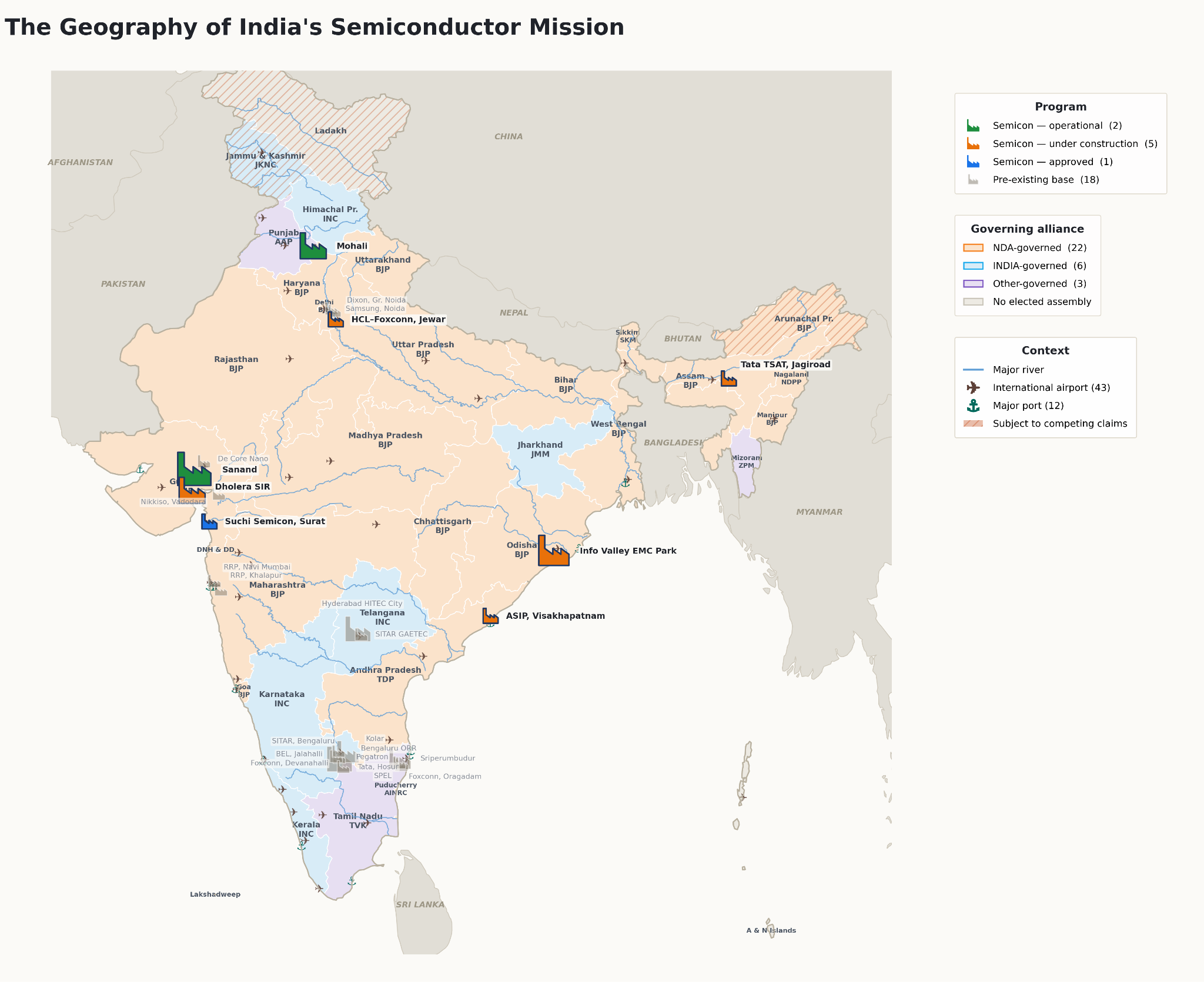
ISM projects sit almost entirely in NDA-governed states, but with 22 of 31 assemblies under the NDA, political alignment is a facilitator more so than a simple selection criterion. The pre-existing base clusters in opposition-governed Karnataka, Telangana and Tamil Nadu.
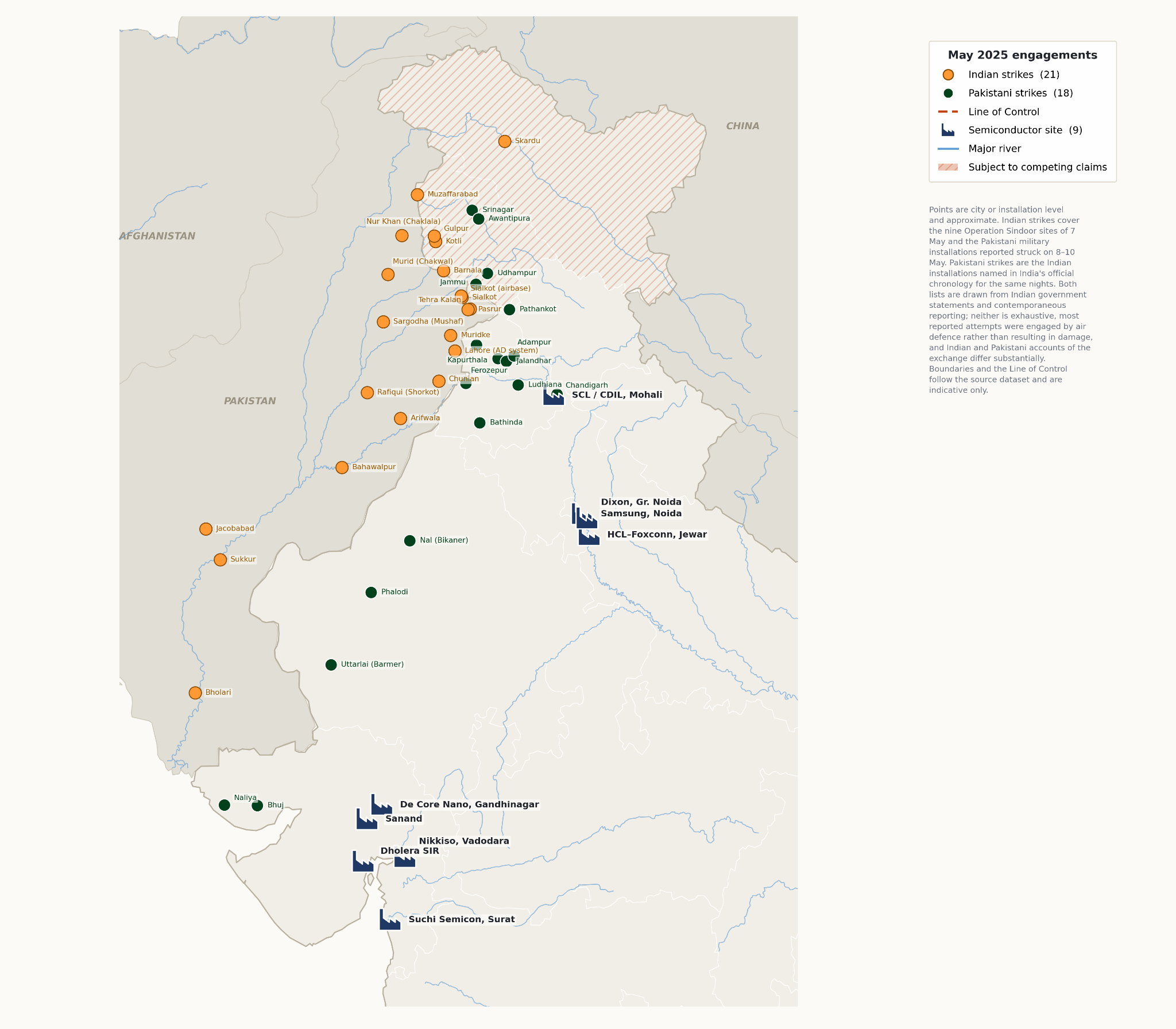
The May 2025 exchange bracketed the northern ISM cluster, with Mohali and Chandigarh inside the ring of Pakistani strikes. Strikes also extended into Gujarat at Bhuj and Naliya. Dholera and Sanand fell outside the envelope, but each cycle in the escalation ladder has widened geographic depth.