
 By
·
4 minute read
By
·
4 minute read
BLUF: Centralization of political and economic authority accelerated across Southeast Asia (SEA) in 2026, particularly in Indonesia and Vietnam. In part, this appears to reflect a broader global trend of stronger national self interest and a slow slide away from the ideals of liberal democratic constructs, but it also reflects the challenge smaller states face amid rising competition between the United States and China. But not all trends are equal. Where centralization is rules-based and predictable – Vietnam's reform agenda, Malaysia's semiconductor strategy – it lowers friction and provides benefits. Where it is personalized and improvisational – Indonesia, Cambodia – it raises expropriation, policy-reversal, and principal-agent risk.
Key Points:
- Vietnam and Indonesia are rapidly centralizing, however the methods and effects diverge. Vietnam is reducing the state’s own friction – fewer provinces, streamlined bureaucracy, faster permits – to entice capital flows. Indonesia is inserting the state into transactions with a sovereign fund that owns the assets, channels exports, and sets terms.
- Global context is a weakened enforcement structure, coupled with a more independent ideological mood. Great powers have reoriented towards national self interest. China+1 premiums have subsidized this reorientation in SEA, with these states continuing to acquire investment despite governance differences.
- The split between rules-based centralization and personalized centralization is a key distinction. Rules-based and institutional centralization can enhance stability and streamline bureaucracy. Personalized centralization can reverse as fast as it is imposed, and is less constrained by national interests.
Southeast Asia’s two primary cases of political centralization in 2026 are Vietnam and Indonesia. They represent broader regional trends, but the implications of their efforts diverge significantly.
Vietnam is using centralization to entice new investment and strengthen its economic position. Under General Secretary To Lam, Vietnam is making itself leaner and more attractive to capital. Provincial administrative units have been cut from 63 to 34, the district tier has been abolished, the bureaucracy is being streamlined, and anti-corruption measures have increased (even if some were more politically motivated than targeting corruption as a practice). This has resulted in fewer regulatory layers and fewer places for local interests to veto or interfere with projects and their permits. Results have shown in data – H1 2026 GDP growth of 8.18%, FDI up 61% Y-o-Y to roughly $35 billion, and World Bank reclassification to upper-middle-income in July 2026. Vietnam’s consolidation of power is real, measurable, and, at least for now, a net benefit to business.
On the other hand, Indonesia is using centralization to coerce actions by foreign investors and existing operating companies. President Prabowo Subianto’s prime instrument has been Danantara, the sovereign wealth fund that now holds state owned enterprise (SOE) assets that he values near a trillion dollars. In 2026 its subsidiary, DSI, became the sole export channel for coal, palm oil, and ferroalloys – a combined $65 billion routed through one SOE, with pricing power and intensive foreign exchange retention rules attached. This builds on the resource nationalism that Indonesia intensified in recent years for nickel and other minerals. A ban on raw ore exports paired with local processing requirements compelled miners to refine domestically before exporting. This is a model that Jakarta is now extending to more commodities further down the value chain (Apple saw this in the temporary restrictions on iPhone sales). The state has transitioned from a regulator of these flows to a direct party to them. Investors have been hesitant – the rupiah has faced weakness and the Jakarta Composite fell nearly 37% from its peak, the worst performance of an Asian major equity index that year. Indonesia’s centralization is also real, measurable, but a net negative to business sentiment.
The key distinction here is not that one country is centralizing and the other is not, nor that one is authoritarian and the other liberal – both are concentrating power, and neither is liberalizing. It is that Vietnam is using consolidation to entice capital, and Indonesia is using it to capture capital.
Throughout Southeast Asia, we see variations of these patterns. Malaysia is concentrated but stable, steady, and rule-of-law focused, though internal political competition regularly resurfaces. Cambodia is maximally centralized, focused on a single personality and familial dynasty. It is predictable, but predictably extractive and China-oriented. Thailand and the Philippines appear to pass through wide swings, with power concentrated, dispersed, or with significant policy swings.
For many, concentrating power helps these countries manage a shifting pattern of global competition. For thirty years, deviating from the liberal template – independent central banks, open capital, civilian control – would draw the ire of Western powers and investors. That influence is waning: the West now runs its own industrial policy and tariffs and can hardly punish others for the same; China proved a large economy can attract capital without the template and offers an alternative source of it; and the China+1 premium quietly pays the governance discount, letting these states deviate and still land the investment.
The semiconductor and affiliated industries will not be immune to these changes. Investment in manufacturing, packaging, and even sales preference stable continuity over speed. Vietnam and Malaysia are currently perceived as credible actors – Vietnam is scaling assembly and its first fabs on long-term strategy. Malaysia is anchoring the high-value packaging and data center boom, and has long been integrated into the regional and global supply chains, particularly through operations in Penang. Indonesia is a data center and critical minerals node (particularly nickel), but local actions via coercive centralization risk reducing long-term confidence in Southeast Asia’s largest country.
What matters for businesses and capital flows is not just how centralized these states are, but how they are centralizing. Vietnam courts investment. Indonesia is trying to force capture. This difference – between enticement and coercion – matters for longer-term continuity, contract enforcement, and whether corruption stays predictable “grease” or turns to obstructive “grit.” However, much of this equilibrium rests on the China+1 premium that makes the coercive path affordable to a state. This premium is a subsidy, not a constant, and a thaw in US-China tensions would strip that subsidy – repricing the coercive bets first.
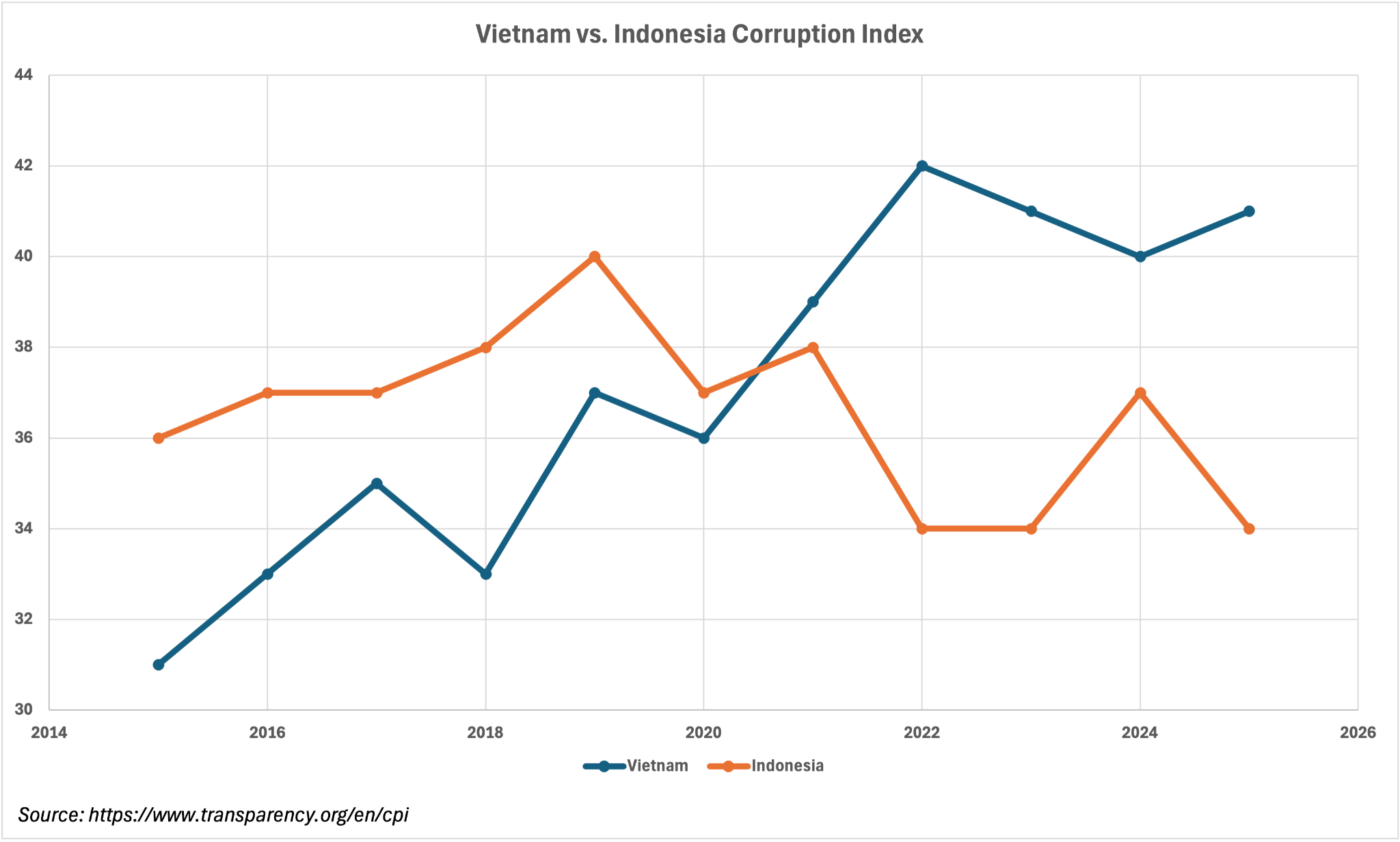
Vietnam vs. Indonesia Corruption Perceptions Index, 2015-2025 (higher = less corrupt): Vietnam has climbed steadily to 41 while Indonesia has slid to 34, the two crossing around 2021 and diverging since – cleaner governance tracking Vietnam's enticing path, decline tracking Indonesia's coercive one.