
 By
·
5 minute read
By
·
5 minute read
BLUF:
Modern attempts to secure critical mineral supplies can benefit from a look at the past to see what strategies were tried, how well they worked, what factors affected success or failure, and how seemingly disconnected events could create new opportunities or risks to key mineral supply chains.
BRIEF:
Last week I had the opportunity to take part in a panel discussion on critical minerals, and it got me thinking about previous times mineral security had shaped geopolitical dynamics. Critical minerals and other strategic commodities have long been the focal point of physical and economic national security concerns. The British worried about Danish control of The Sound, which controlled movement between the Baltic and North Seas, as the British Navy drew heavily on Baltic supplies of timber and cordage to ensure a powerful global maritime force. The need for natural resources in part drove Japanese imperialist policies in the lead-up to World War II, and U.S. actions to constrain Japanese access to key minerals and other natural resources contributed to Tokyo’s fateful decision to attack Pearl Harbor in 1941. China’s threat to ban rare earth mineral exports to Japan in 2010 led to a surge of new exploration and production elsewhere, and drove longer-term attempts to rectify the over concentration of both mining and refining of key minerals by China.
In each of these and numerous other cases, critical materials, whether timber, oil, scrap steel, rubber, or rare earth elements, intersected industrial policies, economic security, national defense priorities, and international relations. Often under-appreciated, each case also highlights WHY such materials often lead to competition and conflict.
First, there is an uneven distribution of natural resources across the globe (which impacts both their accessibility and the routes they travel). Second, countries have different economic and industrial policies and priorities (there is a reason that China now dominates the global rare earth production and processing spaces), as well as social interests, which can incentivise or disincentivise mining and affiliated industries. Third, shifting technologies alter both the types of materials desired and the ways of accessing them (think of the impact of hydraulic fracturing on the relative balance of oil and gas production, or the invention of synthetic rubber). Finally, a less explored dynamic is the frequent reality that several seemingly unrelated factors can impact the relative availability of key resources or commodities.
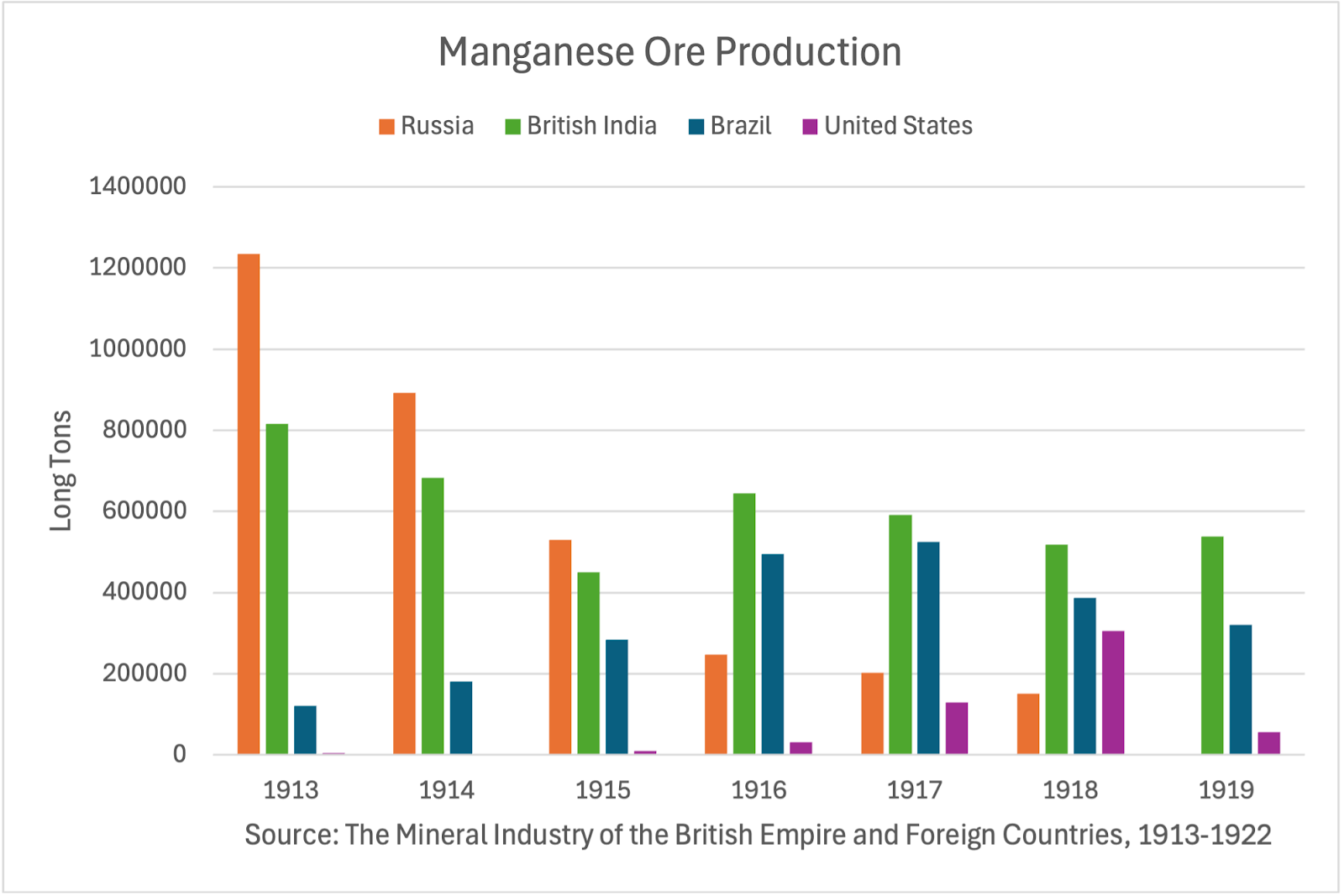
Let's look at a single historical example, to see how these factors come together to create risks and opportunities. In the late 1800s, there was a revolution in steelmaking, with the introduction of several different alloys, rapidly expanding the need for Tungsten, Manganese, and other minerals. In the lead-up to World War I, most global Manganese was being sourced from Russia (in 1913, 54% of global supplies came from the Russian Caucasus and Ukraine) and from British India (India exports in 1913 were about 2/3 those of Russia). Brazil came in a distant third, exporting just 10% of Russia’s yearly total.
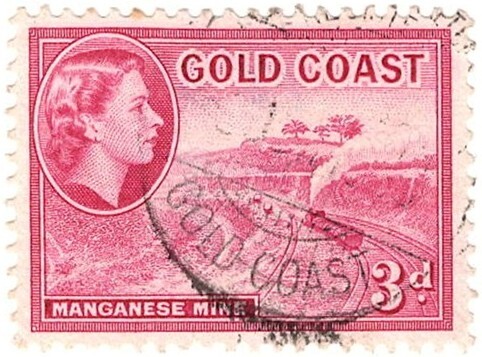
Near the end of 1914, those numbers drastically changed. In September 1914, the Ottoman Empire, having entered the war, closed the Straits of the Dardanelles, effectively cutting off Russian Black Sea ports to its British and French allies. Russian exports of Manganese collapsed, sending both the allies and the United States seeking additional sourcing. Total British imports of Manganese fell from 601,177 long tons in 1913 to 372,724 in 1915. The British sought to expand production in India and turned to another colony, the Gold Coast, as a new source of Manganese ore. The United States looked south, to Cuba, Panama, and in particular, Brazil.
Brazilian Manganese deposits had been discovered in the latter half of the 1800s in central Minas Gerais, some 300 miles inland. By the end of the century, Brazil had steadily expanded exports of manganese ore from the region, taking advantage of the Central do Brasil rail line, which had initially been established to move coffee from the interior to Rio de Janeiro for export. With booming international Manganese prices, and freight rate incentives on the railway, Brazilian Manganese exports rose from 120,335 long tons in 1913 to a wartime peak of 524,291 in 1917, a more than four-fold increase. The next year, things quickly fell apart. U.S. war time restrictions on the export of coal led an already strained Central do Brasil (a rail system designed to carry light weight coffee, not heavy manganese ore) to embargo the shipment of manganese ore on the rail line. Within months, U.S. steel producers were warning that a prolonged shutdown of access to Brazilian manganese would lead the entire U.S. steel industry to shut down by the end of the year. Although a deal was ultimately worked out, the end of the war and an increase in U.S. manganese ore production (rising from just 4,048 long tons in 1913 to 325,000 in 1918) temporarily ended the perceived strategic mineral crisis.
There is much more to the story, but even this brief summary shows how a combination of factors - new technology, transportation infrastructure, maritime choke points, domestic economic policies, war, and politics can lead to wide swings in both critical mineral availability and its sourcing. The incident also points to ways the United States (and other governments) sought to strengthen their own strategic resource supply chains. The initial U.S. response to rising manganese prices and a decline in availability was to seek out new suppliers, mainly from Latin America. It took a push from domestic U.S. industry (steel) to shift U.S. export policy (on coal), allowing the resumption of manganese exports to the United States.
Only late in the war did the United States finally establish a War Industries Board, which was supposed to ensure availability of materials for critical U.S. industries. After the war, while there was still some momentum to ensure future mineral resource security, efforts in general lacked a coherent national strategy or awareness of the way international prices were set. U.S. domestic mineral production during World War I had grown so large that, in the aftermath of the war, the U.S. flooded international markets even as consumption demand fell, collapsing prices and leaving U.S. mining companies in a weaker state.
The war/inter-war pattern continued. During a war, the United States would surge domestic production, seek new suppliers, and establish coordinating bodies that often pursued stockpiling strategies to buffer U.S. industries (including the defense industry) from supply shocks. The inter-war periods saw moves to sell off stockpiles, and allow market forces to reassert themselves over government intervention, often leading to less U.S. capacity and more reliance on distant suppliers. Over and over, the United States pursued a combination of the same tools to strengthen critical mineral supplies - government bodies and regulations established to ensure resilience, the creation of stockpiles, tax and regulatory incentives to drive domestic production, investment in foreign supplies and suppliers, and public attention to perceived vulnerabilities. And in each cycle, as the sense of crisis waned, stockpiles were reduced or eliminated, regulations shifted to preference environmental or other issues over mineral supplies while NIMBY sentiments increased, and investments abroad often faced cycles of nationalization or social disruptions.
The United States is once again facing a critical minerals challenge, and it is turning to many of the same tools of the past. If history is a guide, the biggest constraint will not be political will, it will be the lack of effective coordination between the government, industry, and society, and with allies and partners, that will drive another round of the cycle. Mining is a long-term industry - in the United States regulatory hurdles mean that new mines take more than a decade to begin operations (and even longer to turn a profit). Even restarting a shuttered mine can take five years or more - and that is assuming there is little local opposition and plenty of available labor. Refining is likely to take even longer, particularly with the loss of skilled expertise in the United States (the last major domestic rare earth processing facilities shuttered back in the 1990s). Resiliency will require not crisis thinking, but long-term strategic foresight, regulations that far outlive political cycles, and effective coordination among government, producers and consumers of critical minerals, society, and finance. Without such a shift, we are likely to once again see a short-term response that fades after the next perceived crisis passes, leaving the United States vulnerable to future disruptions.