
 By
·
5 minute read
By
·
5 minute read
BLUF
Seoul has made semiconductors and AI the organizing principle of a new national economic and security strategy. However, South Korea controls almost none of what that strategy foundationally requires. Critical inputs come from China, Japan, and further afield, equipment and export controls come from the U.S., and electricity comes from a perpetually lagging Korean power grid. The Lee government’s hedging – a $350 billion investment package for Washington and a summit thaw with Beijing – manages the first two dependencies without resolving either. It cannot fix the third dependency in the near-term.
Key Points
- The current progressive government has reoriented Korea’s policy priorities, reducing focus on North Korea threats and focusing its security concerns more in the maritime space - a recognition of the Peninsular nation’s vulnerability to supply chain disruptions.
- Korea is squeezed from both sides of the same supply chain. U.S. equipment and export controls, coupled with China’s upstream dominance, sandwich Korean ambitions. Korea also shares Japan’s WF6 exposure, and has no domestic refining.
- Indispensability and exposure are two sides of the same coin. Korea plays a key roll in the memory layer, but growing demand is leading to expanded competition from Micron and newer Chinese firms.
- The Korean power grid is a binding constraint on national strategy. Requisite transmission projects are stalled, blocked, or lagging. Korea is an electrical island with no interconnections to import power when margins tighten.
South Korean President Lee Jae-myung took office in June 2025 on the heels of Yoon Suk-yeol’s martial law and impeachment controversy – a restoration of “progressive” leadership following several years of “conservative” rule. The shift between Conservatives and Progressives or Liberals follows a familiar pattern - the DPRK is de-emphasized as an organizing threat, engagement is preferred, and “strategic autonomy” is the stated goal (i.e. a reduction of dependence on the United States for South Korea’s national security). To strengthen Korea’s autonomy, Lee has pledged 100 trillion won (~$67 billion) over five years to make Korea a top-three AI and semiconductor power. He personally chairs the National AI Strategy Committee, tripled AI spending, and secured nearly 300,000 Nvidia GPUs. Samsung and SK Hynix are committing $518B into a southwestern chip hub alongside the existing Yongin megacluster. Korea already has a near-monopoly on the memory layer of the AI stack; they are now seeking to capitalize on that and shift from an exporter of memory chips to the processor and user of the chips. In short, what traditional natural resource producers have done by demanding refining and other secondary functions in-country to climb the value chain, South Korea appears to be pursuing from a technology supply chain standpoint.
Dampening these ambitions are a series of constraints. Korea is squeezed from both ends of the same supply chain. Washington controls the equipment, design software, and – since the August 2025 Validated End-User (VEU) revocation – the export controls governing where Korean firms may produce. Beijing controls what inputs go into the machines. The sharpest of these is a chokepoint Korea cannot hedge. Tungsten hexaflouride, WF6, is the gas used to deposit tungsten contact layers in 3D NAND, DRAM, and sub-7nm logic chips. Samsung and SK Hynix have historically sourced the majority of their WF6 from Japan. Beijing has starved the Japanese producers and output has been curtailed.
Korea has no domestic tungsten refining, and while Beijing has not yet extended Seoul the Tokyo treatment, it sits downstream of China-Japan trade conflicts. Korea’s domestic Almonty Sangdong tungsten mine, reopened in 2026 in Gangwon, produces concentrate that must be shipped abroad for processing; its output is largely contracted to US defense end-use; and its planned Yeongwol plant is designed for nano-tungsten oxide, not the high-purity powder WF6 production requires.
Underneath these mineral issues run two slower, yet just as important, constraints: Korea ranks near the bottom of the OECD for retaining AI and semiconductor talent, and the logic value in its own products is migrating outward. TSMC builds the High Bandwidth Memory (HBM) base dies for SK hynix and Micron (Samsung continues to take an internal integrative approach), and SK is collaborating with the Taiwanese firm on next generation HBM. Korea’s UNIDO (industrial development) competitiveness index has fallen from 0.41 to 0.33 since 2012, while China has risen past this to 0.38. These constraints differ in severity and speed. All of them shape what Korean fabs can produce. However, none of them determine whether a fab can even be turned on.
The Korean energy grid is where this bet meets reality. Lee positioned himself as a renewables-first president, dismissing the previous conservative government’s nuclear reactor plans at his 100-day press conference. AI and semiconductor demand coupled with 80% public support has moved him. His administration now describes a “third way,” and has become, in practice, the most nuclear expansionary Korean government since 2015. In January, the Climate and Energy ministry confirmed that the previous government’s 11th Basic Plan’s two large reactors (2.8 GW) and one Small Modular Reactor (SMR) would proceed, targeting 2037-2038 completion. This expansion does not address fab need timelines nor Korea’s primary energy constraint – transmission.
Korea generates power at its coasts and consumes inland. Nuclear plants run down the southeastern shore, coal and LNG cluster on the west, and renewables in the south. Meanwhile, the semiconductor fabs and AI datacenters cluster in a tight belt south of Seoul – at Hwaseong, Pueongtaek, Icheon, and Yongin. Connecting dispersed production to clustered consumption is a prime initiative for Korea Electric Power Corporation (KEPCO). But budget issues and lagging projects continually hamper this.
Roughly 6 GW of the megacluster’s requisite 15-16 GW has no finalized supply plan. The 500 kV Donghaean-Dongseoul High-voltage Direct Current (HVDC) line – 280 km, 436 towers, carrying around 8 GW from east coast reactors – dead ends at a converter station Hanam rejected in 2024. The 345 kV Bukcheonan–Singiheung feeder into Yongin, one of 99 “national backbone” projects, was expected in 2032. Timelines have now been pushed to 2036 at the earliest. The line feeding into Bukcheonan has no agreed route at all; its siting committee collapsed repeatedly for lack of quorum amid resident blockades. The West Coast subsea HVDC that would move Honam’s power northwards remains unbuilt, languishing in the planning stage. Korea has no electrical interconnection with any neighbor, so there is no relief valve to open when margins tighten. Additionally, KEPCO’s track record is grim – Bukdangjin-Sintangjeong took 22 years and cost KEPCO 1.17 trillion (~$800 million) won in delay losses. Curtailment, too, is now rising for nuclear and renewables, because generation is outpacing transmission.
Korea’s problems are not unique. Every state building AI capacity at scale is facing similar constraints – grid capacity, water resources, and local resistance. Capital is mobile, and some large-scale data centers are moving toward their own off-grid power supplies, but water and neighborhoods are much less adaptable. Seoul has been successful for now balancing between its economic links to Washington and Beijing, and using its domestic capacity to make itself important to both. But that can only go so far, and the government is seeking ways to limit Korea’s vulnerability to its two largest economic partners. Unfortunately for Seoul, Korea’s national strategy currently hinges more on whether it can get transmission lines built in a timely manner than on great power politics.
________________________________________________________
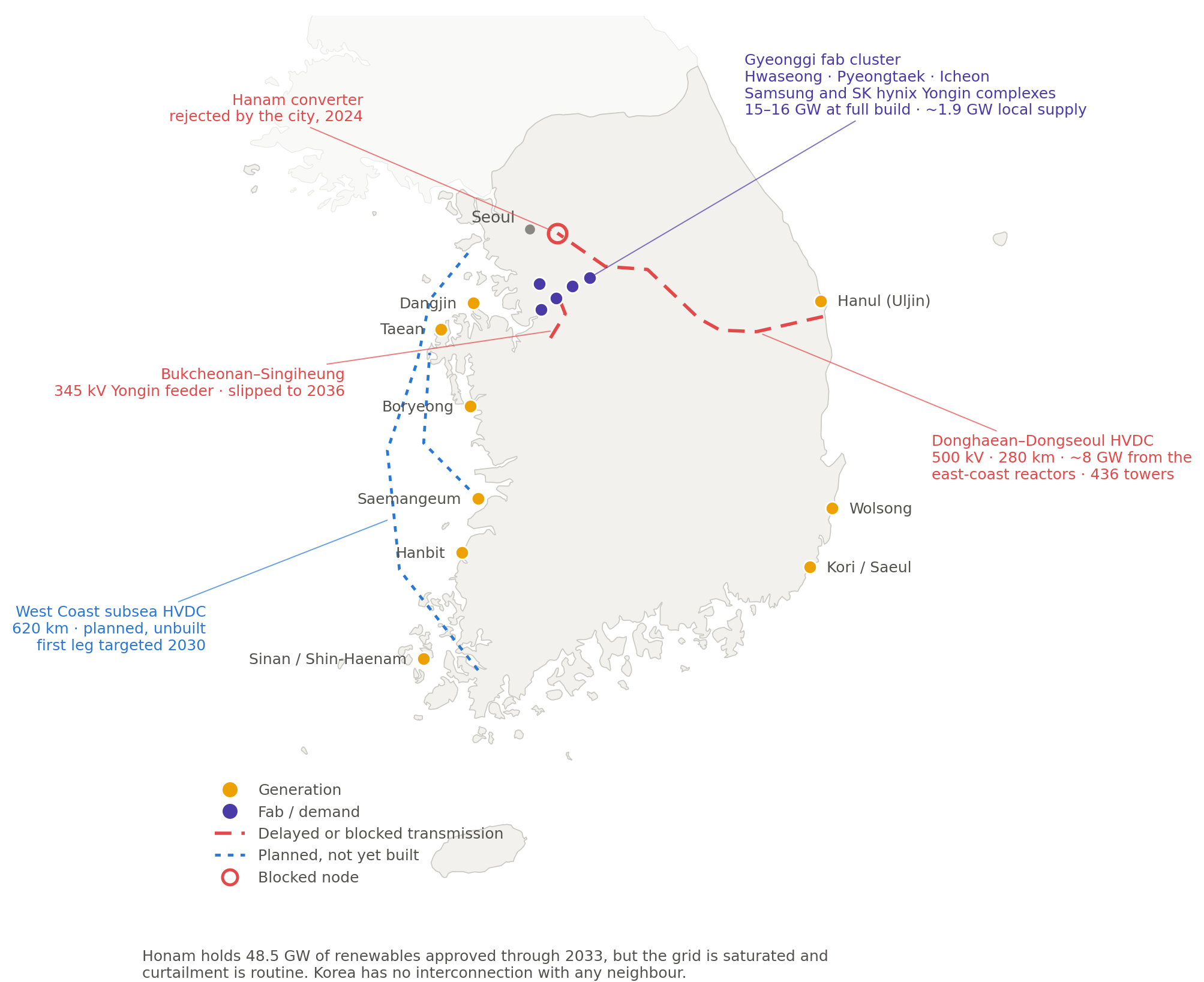
South Korea generates its power at the coasts and consumes it inland. The two lines meant to close that gap are unfinished – the Donghaean-Dongseoul HVDC and the Bukcheonan-Singiheung hub feeder. The West Coast subsea HVDC remains in the planning stage. Korea has no grid interconnection with any neighbor, so there is no import valve when margins tighten.
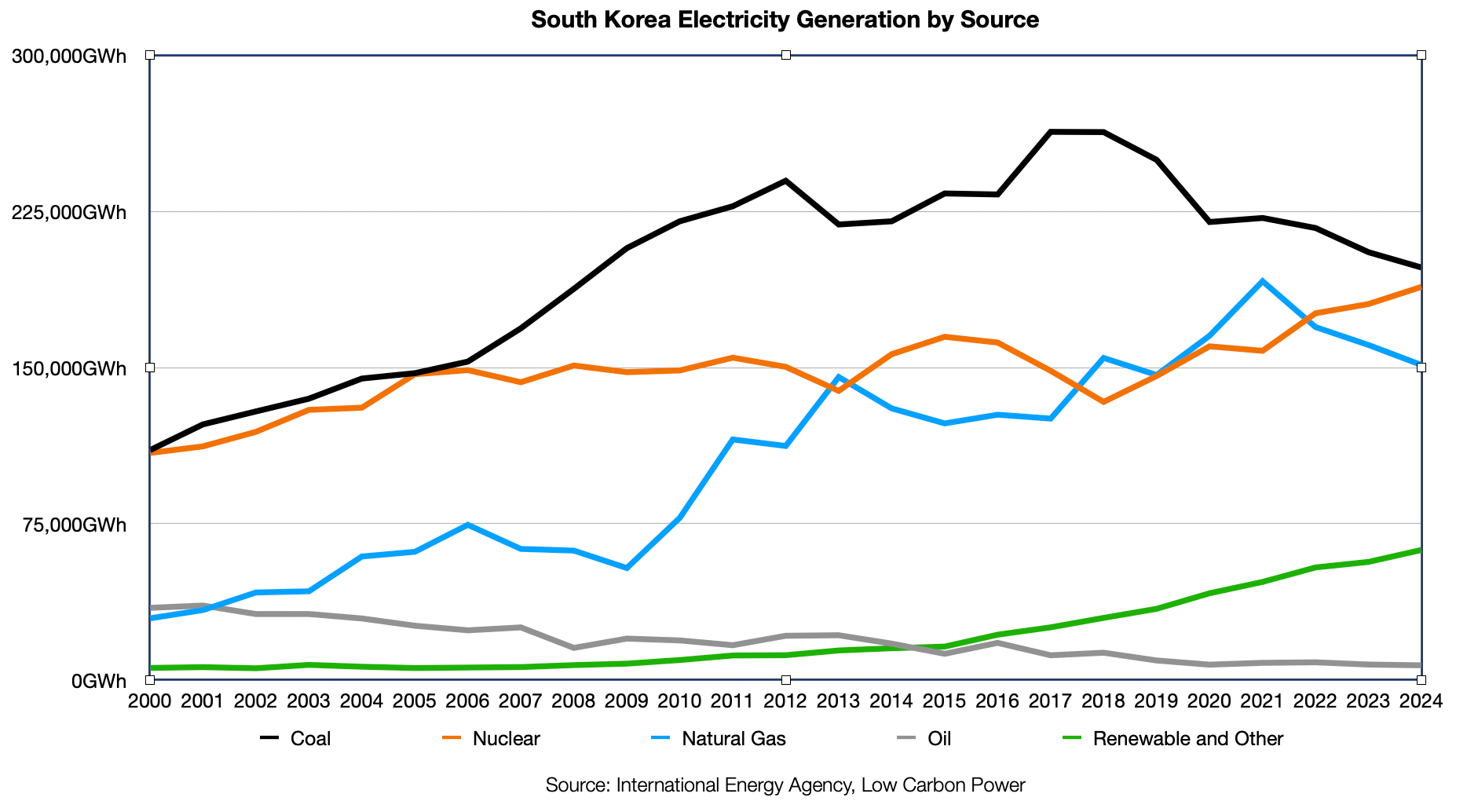
South Korea’s electricity production is primarily an even mix of coal, nuclear power, and natural gas. Coal and natural gas are imported from countries such as Australia, the United States, and Qatar. Nuclear energy is a primary policy focus, and is on track to become South Korea’s largest source of energy - one less vulnerable to overseas shocks.