By
·
6 minute read
By
·
6 minute read
BLUF
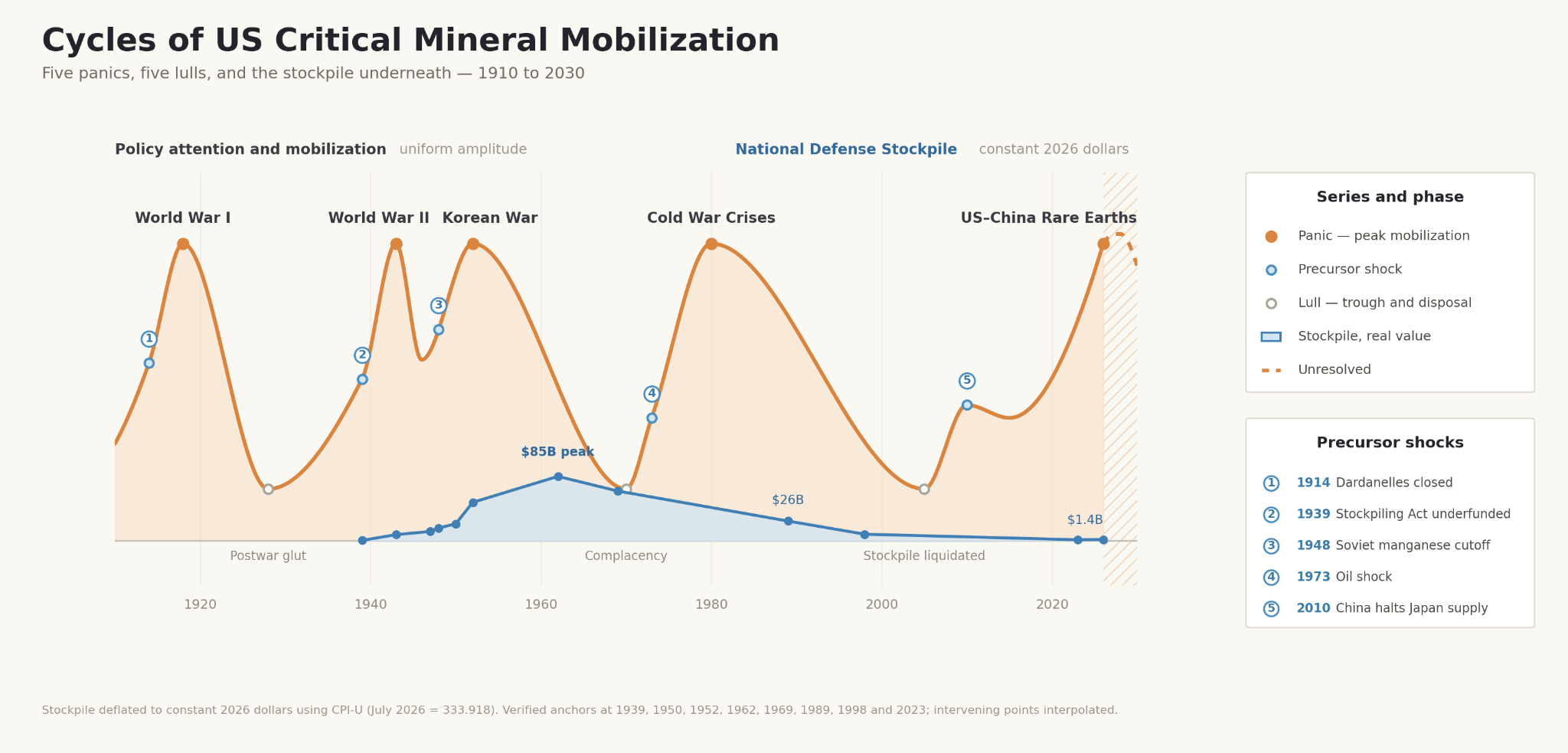
Over the past century, the United States has faced repeated cycles of concern over access to critical minerals. Within these cycles, the responses share similar patterns. A shock occurs, political will surges, stockpiles are aggregated, and then there is a drawdown. The responses to the newest perceived crisis appear different. Washington is introducing federal equity stakes in miners and refiners, a long-term price floor, stockpile increases, and creating a plurilateral pricing coalition in the form of the Forum on Resource Geostrategic Engagement (FORGE). Historically, liberal democracies’ structural incentives have constrained the effectiveness of such programs. Whether this cycle disrupts the pattern remains to be seen. The outcome depends on coordination across government, industry, and allies, and market architecture that incentivizes private capital.
Key Points
- The US has experienced similar shock-surge-stockpile-complacency-selloff loops fourth times since the War Industries Board coined “strategic minerals” in 1917.
- The National Defense Stockpile is a key indicator of changing political will – peaking near $9.6 billion in 1989 (~$21.9 billion in today’s dollars) and currently sitting around $1 billion.
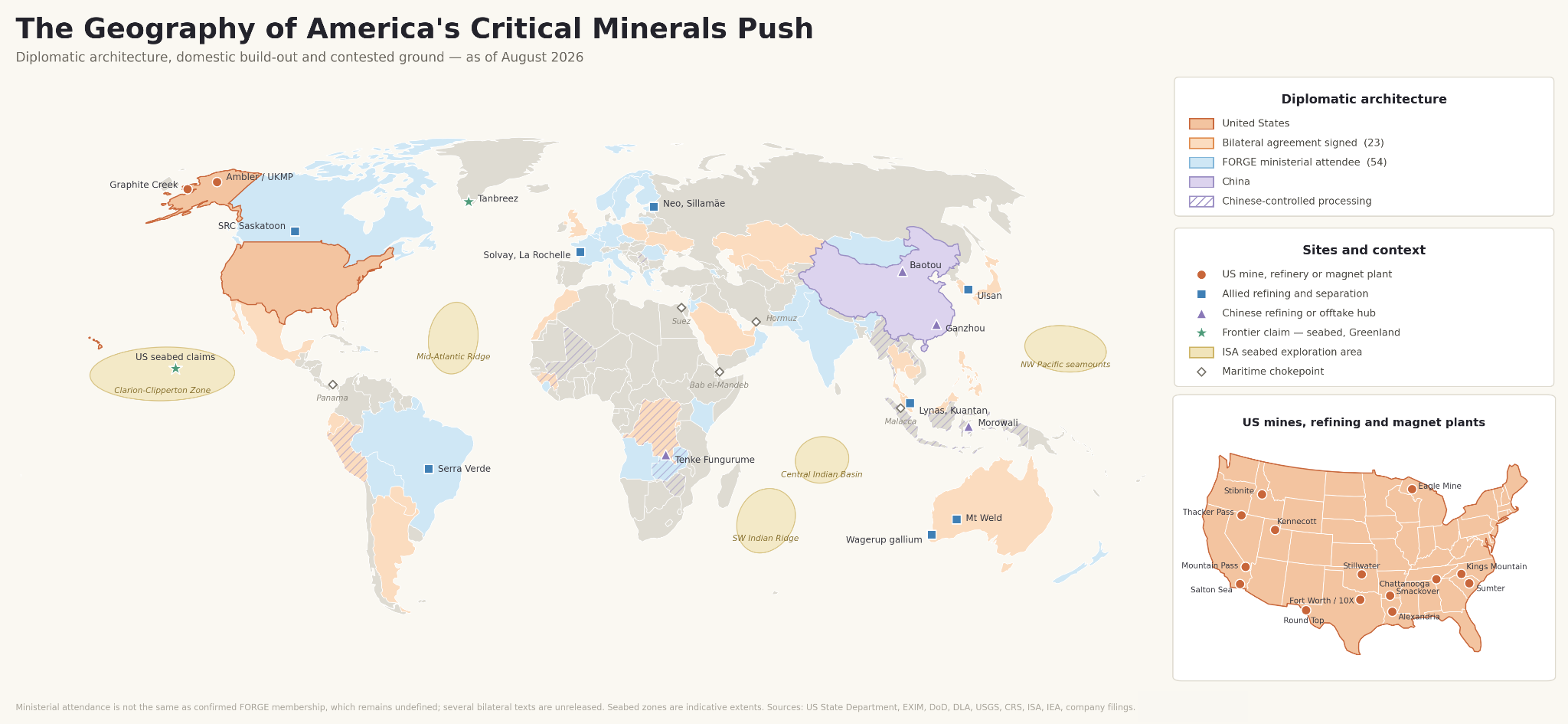
- China’s dominance is midstream and has been deliberately constructed. Beijing controls roughly 90% of rare earth separation and 99% of gallium refining. This has been built over three decades of targeted industrial policy.
- Economic coercion in critical minerals now reaches civilian supply chains. From the 2010 Japan-China disruptions to the 2025 idling of US auto plants, and more recently China’s cutoff of tungsten powder to Japan, the target set has expanded.
- Washington has crossed a market intervention line into direct ownership. Equity stakes in MP Materials, Lithium Americas, Trilogy Metals, etc. – the sharpest break from post-1980 market orthodoxy in the sector’s history.
- The binding constraint is not just political will, but also coordination and financeability. The latter two remain largely unresolved.
Historical Context
Cycles of concern over critical minerals access have been relatively consistent, showcasing similar patterns each time. These are rarely just about geology, and more often emerge where new technology, transport infrastructure, maritime chokepoints, domestic economic policy, and war (or the potential for war) collide. When several of these factors move simultaneously, a crisis cycle follows. A shock reduces or severs access to materials that the economy and national defence depends on. In response to this shock, political will surges and Washington undertakes a frenzy of initiatives. Forums and coordinating bodies are established, domestic production subsidies are instituted, new suppliers are explored, price floors are established, and inventory is purchased. Then, the shock passes and attention refocuses elsewhere. The stockpile is perceived as excess and is liquidated, while subsidies are considered economically inefficient – unable to survive at peacetime prices. The five cycles below show the mechanisms, and how they’ve evolved over time.
World War I: In 1913 Russia supplied 54% of the world's manganese from the Caucasus and Ukraine. Then the Ottomans entered the war and closed the Dardanelles in September 1914. Russian exports collapsed. Britain turned to India and the Gold Coast. The United States turned south – to Cuba, Panama, and above all Brazil, where exports climbed from 120,335 long tons in 1913 to a wartime peak of 524,291 in 1917.
Then, the crisis abated. US wartime coal export restrictions strained the Central do Brasil railway – built to haul coffee, not ore – until it embargoed manganese entirely. Within months American steelmakers were warning that a prolonged shutdown would close the domestic steel industry by year's end. A deal was negotiated, and domestic production surged from 4,048 long tons in 1913 to 325,000 in 1918. Then the war ended and the crisis evaporated. US wartime production grew so large that postwar oversupply collapsed prices and left American miners weaker than they had been in 1914.
World War II: Preceding World War II, The Strategic and Critical Materials Stock Piling Act of 1939 authorized $100 million against 42 materials; when Pearl Harbor occurred, only $54 million had been acquired. The postwar assessment called it gravely inadequate.
Korean War: Korea drove the fastest buildup on record – roughly $2.9 billion appropriated in six months, inventory to $4.02 billion by 1952. The Defense Production Act of 1950 supplied loans, guarantees, and purchase commitments; by 1953 the government had executed more than 425 exploration contracts. Truman's Paley Commission published Resources for Freedom in June 1952 and argued for securing access through partnership rather than coercion – a framing worth looking at as FORGE takes shape.
Cold War Crises: From 1970-1985, with roots in the Congo Crisis, another cycle weighed on US interests. Katangese rebels seized Kolwezi in May 1978. Zaire produced roughly 90% of world cobalt. Prices ran from $5.62/lb in 1977 to $32.83/lb in 1979. The Reagan-era "resource war" debate followed, fixated on Soviet resource denial and southern African chromium, manganese, and platinum-group metals. Resources for the Future judged the thesis implausible at the time – African governments consistently wanted to sell more to the West, not less. That corrective has aged well and is worth applying to current threat framing.
Then, the Soviet Union collapsed and the drawdown came. Between 1989 and 2009, Congress authorized "excess" sales and routed proceeds elsewhere; more than $6 billion went to the General Fund between 2002 and 2022 alone. The Bureau of Mines was abolished in 1996, ending nearly a century of dedicated minerals analysis. Just-in-time sourcing became doctrine and domestic processing withered.
Why the Cycles Repeat
This is not to say that these cycles are failures or indictments of American competence – they’re structural features of liberal democracies. Halford Mackinder, writing at the conclusion of the first world war, noted that “democracy refuses to think strategically unless and until compelled to do so for purposes of defence.” And the incentives make that so. Electoral cycles run on timelines of only a few years, markets allocate capital towards returns and efficiency, and resilience is a public good – not something that is structurally incentivized at the firm level. On the other hand, as Mackinder notes, when democracies are compelled, they can move rapidly and at great scale. The compulsion has arrived as Western countries seek to de-risk from China. What remains to be seen is whether this cycle will repeat the same patterns, or produce durable critical minerals security.
What is Washington Building Now?
Today, the US is facing its fourth cycle. This cycle began in 2010 when China apparently halted rare earth shipments to Japan after the Senkaku maritime collision. Prices spiked roughly tenfold. As an acute example, the firm Molycorp raised capital, built the Mountain Pass mine, and then went bankrupt in 2015, with $1.7 billion in debt, when Beijing relaxed quotas. Molycorp was sold for $20.5 million, with a Chinese firm holding a non-voting stake in the acquiring consortium.
China’s April 2025 licensing regime on seven medium and heavy rare earths was the trigger. The October 2025 escalation – an extraterritorial 0.1% de minimis rule reaching any foreign product containing trace Chinese-origin material – was the shock. The Trump-Xi summit in Busan bought a one-year pause. It resolved nothing permanently. Though, Washington’s response has been fast and novel.
- The MP Materials deal (July 2025). $400 million in DoD preferred equity plus warrants, taking the Pentagon to roughly 15% ownership. A ten-year NdPr price floor at $110/kg structured as a contract-for-difference – nearly double market (as of 2025) and more than double MP's realized 2024 price of about $51/kg. A ten-year offtake on the entire output of a new 7,000 t/yr magnet plant. Apple followed with $500 million for recycled magnets.
- Equity stakes in Lithium Americas (5%), Trilogy Metals (10%), USA Rare Earth and others – roughly $3 billion in conditional investments across seven companies.
- Project Vault (February 2026). A ~$12 billion strategic reserve built on a $10 billion EXIM loan, the largest in that bank's history, plus private capital from Hartree, Traxys, and Mercuria. Demand-led: manufacturers commit to buy at fixed prices and carry storage and interest.
- FORGE. Launched 4 February 2026 as successor to the Minerals Security Partnership, chaired by South Korea, with 54 countries at the inaugural ministerial. Vance floated reference prices at each production stage, defended by adjustable tariffs. In plain terms: internationalize the price floor so US taxpayers do not carry it alone.
- EO 14241 invoked DPA Title III. A Section 232 investigation found imports threaten national security – and then, in January 2026, declined to impose tariffs, opting for negotiation and minimum import prices instead.
What is different this time?
Four non-trivial factors separate this critical minerals cycle from prior ones:
- China's dominance sits in the midstream – separation and refining, not raw ore. That is a policy achievement rather than a resource endowment, which means the bottleneck is capital, expertise, and tolerance for environmental mess rather than geology. It is expensive but solvable, on a very different timeline than, say, EUV lithography.
- The export controls are extraterritorial. The 0.1% rule has no precedent in minerals. It mirrors and inverts American semiconductor practice.
- The coercion reaches consumers. Rare earth licensing shuts car lines and semiconductor fabs, not just defense primes. That widens the domestic constituency for a response and the adversary's target set simultaneously.
- The state is now an owner. Price floors, equity stakes, and offtake guarantees are not the toolkit of market orthodoxy.
However, permitting and capital intensity have not moved. US regulatory hurdles mean new mines take more than a decade to reach operation, restarting a shuttered mine can take five years or more, and refining is likely slower still given how much metallurgical expertise the country lost when domestic rare earth processing shut down in the 1990s. China can still crush prices. That is what killed Molycorp, and it is what the new $110/kg floor exists to blunt.
And, the funding remains lacking. Project Vault plus MP plus the equity stakes runs to perhaps $30-40 billion against a $29 trillion economy. Credible estimates put Chinese industrial policy near 1.7% of GDP annually. Washington is not just converging on Beijing's model. It is making targeted chokepoint bets – which is the right instinct, but it can’t match the scale.
Conclusion
The key question is not whether Washington sustains its enthusiasm, but whether it builds the two things every prior cycle lacked. The first is coordination: twenty-one bilateral frameworks, a plurilateral forum, a stockpile, and a price floor amount to little if they are never wired to one another. The second is financeability. Strategic importance and bankability are different things, and projects stall not because the deposit is uninteresting but because they never become legible enough for lenders and boards to underwrite. A price floor with no termination condition is a subsidy, not a market; a reference price is meaningless until allies agree on what counts as non-China supply, which no one has yet defined. The longevity of this cycle’s instruments will be tested when the Busan suspensions expire in November and Congress decides whether Project Vault and the stockpile become law or remain executive instruments. Cycle four has better tools than its predecessors. It does not yet have better architecture.
Additional author contributions from Ethan Burk